

A Responsible, Loving Decision for Your Pet

Having your pet spayed or neutered is one of the most caring choices you can make as a pet parent. These procedures can help reduce the risk of certain health concerns while also supporting positive behavior at home. Our team takes time to explain options, timing, and expectations so you feel informed and confident moving forward.
Benefits of Spay & Neuter

Supporting long-term health and well-being

Spay and neuter procedures offer benefits that go beyond preventing unplanned litters:

  • Female pets: May experience a reduced risk of certain reproductive health conditions and no longer go through heat cycles
  • Male pets: May show fewer hormone-related behaviors, such as roaming or marking
  • All pets: Many pets go on to live longer, healthier lives after spay or neuter surgery

We’re happy to discuss how these benefits may apply to your pet’s age, breed, and lifestyle.

What to Expect

Careful planning and attentive monitoring

Your pet’s safety begins well before surgery. Each patient receives a thorough physical exam and appropriate pre-surgical testing to help evaluate overall health. We’ll review your pet’s medical history and provide clear pre-operative instructions to help you prepare.

During surgery, our modern surgical suite allows for continuous monitoring of vital signs and anesthesia levels. Our team focuses on maintaining a clean, controlled environment while prioritizing comfort and safety from start to finish.

Post-Operative Care

Guidance and support during recovery

Recovery is just as important as the procedure itself. After surgery, you’ll receive detailed instructions for at-home care, including activity restrictions, incision monitoring, and pain management guidance.

Our team remains available to answer questions and address concerns throughout your pet’s recovery period.
Schedule Your Pet’s Spay or Neuter in Charlotte

Supporting a healthy, happy future

If you’re ready to take the next step, contact Park Road Animal Hospital to schedule a spay or neuter consultation in Charlotte. We’ll help you plan with confidence and provide the care your pet deserves.

Female Vet with Dog

Frequently Asked Questions: Spay & Neuter

Ovariohysterectomy — removal of both ovaries and the uterus through an incision in the abdomen. Some surgeons perform ovariectomy instead, removing only the ovaries; the outcomes for behavior, mammary tumor prevention, and pyometra prevention are equivalent, since it is the hormonal cycling from the ovaries that drives those conditions. Both are done under general anesthesia with full monitoring and multimodal pain control.

Castration — removal of both testicles through a small incision in front of the scrotum in dogs, or through the scrotum in cats. The scrotum itself is left in place; in dogs it flattens over the following weeks. It is a shorter procedure than a spay with a quicker recovery, but it is still abdominal-grade surgery in terms of the aftercare it deserves.

  • Females: eliminates the risk of pyometra and of ovarian and uterine disease; greatly reduces mammary tumor risk when performed early (roughly half of canine mammary tumors and the great majority of feline ones are malignant); no heat cycles, bleeding, or unwanted litters
  • Males: eliminates testicular cancer; prevents benign prostatic hyperplasia, prostatic cysts and infection, and perineal hernia; reduces roaming, urine marking, and some forms of inter-male aggression
  • Both: no unwanted litters, and in males a reduced tendency to escape and be hit by a car or injured in a fight

This has genuinely changed in recent years, and the honest answer is that it depends on species, breed, size, sex, and lifestyle.

  • Cats: around five to six months is standard, before the first heat. Early-age sterilization from about eight weeks is safe and is widely used in shelter medicine.
  • Small-breed dogs (under roughly 45 lb adult weight): around six months is generally appropriate, as orthopedic concerns are minimal in these breeds.
  • Large and giant-breed dogs: there is good evidence in several breeds that sterilizing before growth plates close raises the risk of cranial cruciate ligament rupture and hip dysplasia, and in some breeds of certain cancers. Many of these dogs are better served by waiting until 12 to 18 months, or by an alternative such as vasectomy or ovary-sparing spay where appropriate.
  • Female dogs specifically: mammary tumor protection is greatest when spayed before the first heat and decreases with each subsequent cycle, so there is a real trade-off to weigh against orthopedic considerations.

We would rather have this conversation about your individual dog than apply a single rule to every patient. Your household situation matters too — an intact female in a home where an unplanned litter is a real possibility is a different calculation.

Personality — the core temperament — does not change. What may change are hormone-driven behaviors: roaming, marking, mounting, and heat-related behavior. Fear-based or anxiety-based aggression is not reliably improved by neutering and can occasionally be worse; we’re happy to discuss behavior specifically if that is part of your reason for considering it.

Weight gain is real but manageable. Metabolic rate drops after sterilization, so a pet fed the same amount will gain. Reduce the portion by roughly a quarter after surgery, or switch to a diet formulated for sterilized pets, and monitor body condition. Sterilization does not make a pet fat; unchanged feeding does.

Food is withheld from the night before, with water available. At drop-off we perform a physical exam, confirm the plan, and run pre-anesthetic bloodwork. Your pet receives pre-medication with pain control, an IV catheter, fluids, and then induction and intubation with continuous monitoring throughout. Local blocks and, for spays, an intra-abdominal or incisional block, are commonly used in addition.

Most routine spays and neuters go home the same afternoon, awake and comfortable, with pain medication and written instructions.

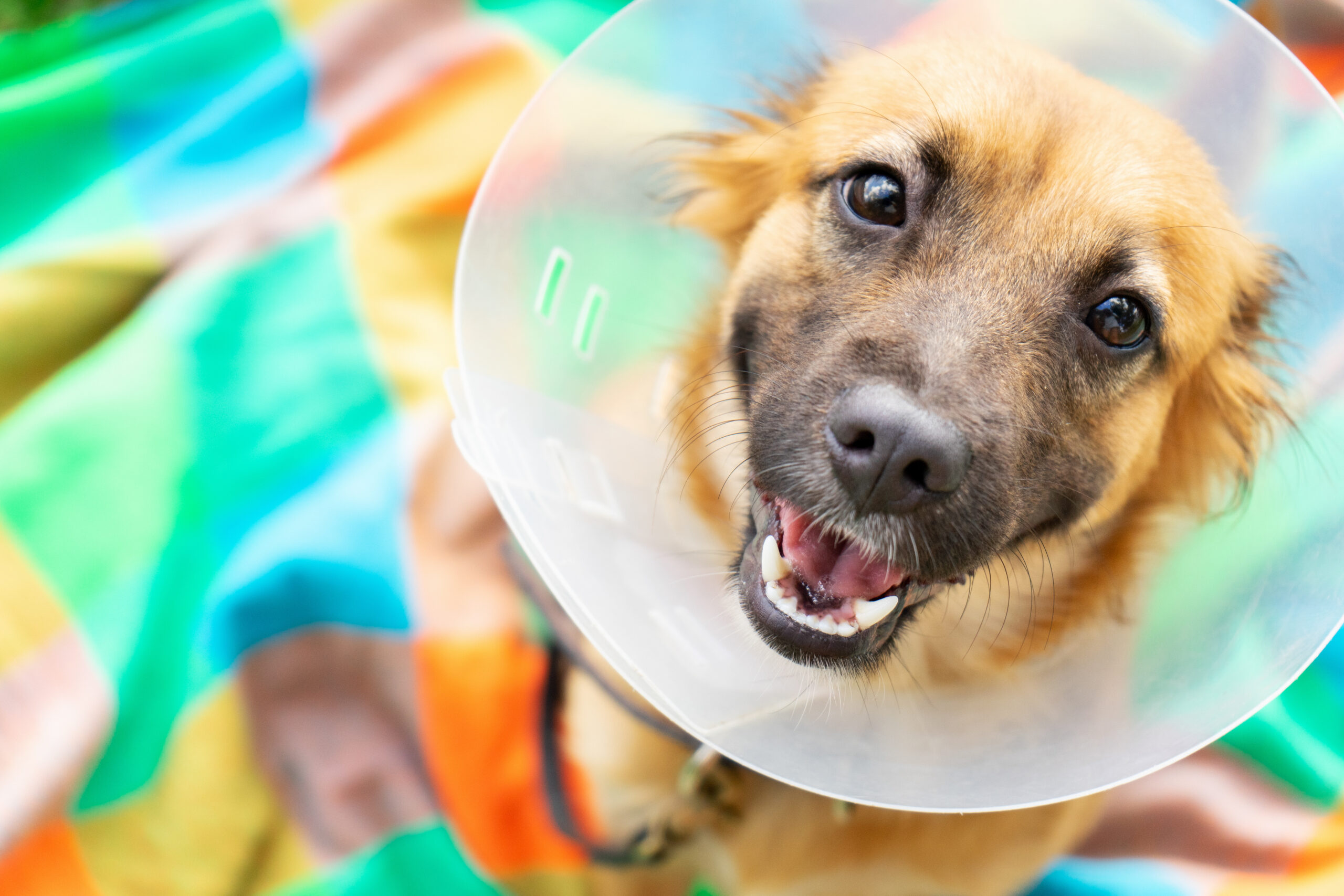
  • Cone or recovery suit at all times for 10 to 14 days
  • Leash walks only for elimination — no running, jumping, stairs, or play
  • No baths, swimming, or ointments on the incision; keep it dry
  • Check the incision twice daily
  • Give pain medication as directed, and never give human medications
  • A small amount of grogginess and reduced appetite on the first evening is normal

Most incisions are closed with absorbable sutures under the skin and need no removal; if skin sutures or staples were placed we will schedule their removal. A small firm lump under a healing incision is usually normal suture reaction, but have us look at anything you are unsure about.

That is cryptorchidism, and it is a reason to neuter rather than a reason to wait. A retained testicle sits at body temperature instead of in the scrotum and has a markedly higher risk of becoming cancerous, as well as a risk of twisting on itself. It is also heritable, so affected dogs should not be bred.

The surgery is more involved than a routine neuter because the retained testicle must be located — in the inguinal region or inside the abdomen — so it takes longer and costs more, and recovery follows abdominal surgery precautions if the abdomen was entered.

Yes, in both cases, but with important caveats. During heat the reproductive tract is engorged with blood, which lengthens the surgery and increases bleeding risk. When it is elective, we prefer to wait until two to three months after the cycle ends. When it is not — a pregnancy the owner cannot continue, a pyometra risk, a scheduling reality — it is done, with the risks discussed beforehand.

Please tell us if there is any chance your pet is pregnant or has recently been in heat. It changes our planning, not our willingness.

Spay and neuter are among the most commonly performed surgeries in veterinary medicine and complications are uncommon. Those that occur include anesthetic reactions, bleeding, incisional infection or swelling (most often from licking or over-activity), suture reaction, and — in females, rarely — urinary incontinence later in life, which is usually well controlled with medication.

The great majority of complications we see are self-inflicted during the recovery period. The cone and the leash are doing more work than they get credit for.

After hours? If your pet has a surgical emergency when we are closed, go directly to your nearest 24-hour emergency veterinary hospital. During opening hours call us at (980) 981-4334.